
What it means to me
PROTECTED CONTENT
If you’re a current subscriber, log in below. If you would like to subscribe, please click the subscribe tab above.
Username and Password Help
Please enter your email and we will send you a password reset link.
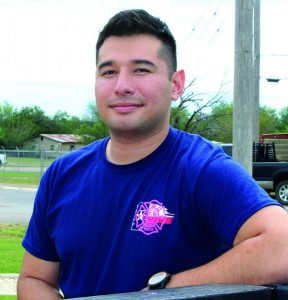
Omar Salgado’s parents didn’t want him to join the US Marine Corps.
In fact, they didn’t want him to join the military at all.
But the youngster from Los Angeles, California, had his heart set on serving in uniform. He believed it was his calling, and he was eager to answer it. Throughout his formative years, he could think of nothing else.
By the time he was in the sixth grade, he knew that he would be a US Marine.
In his ninth- and tenth-grade years, he developed a rapport with recruiters, learning as much as he could about serving his country, and how much of a commitment it would entail.
Omar brought home the permission slip that he had been offered, a piece of paper on which is parents would sign their names to allow him to join the US Marine Corps before he turned 18.
“It took some persuading,” he grins today. “My mother was just so reluctant. At the time, I was an only child. I was the baby, so to speak. But I was becoming an adult, and I had a decision to make. I wanted her to support me.”
It had been 15 years since the United States had been attacked on September 11. Omar had grown up in a world in which conflicts were not as easily defined as they had been in the history classes that he had enjoyed so much.
“I thought of conflict in terms of the first and second world wars,” he says. “I thought of serving my country against a known enemy. But everything had changed when I was young. The world had come to know terrorism, global threats, militant factions, insurgency… We had gone to war in Iraq and Afghanistan in ways that were hard to define.”
Omar’s mother signed the permission slip.
“I had gone through the delayed-entry program by then,” he says of his last year in high school. “I was ready for it.”
Camp Pendleton outside San Diego in Southern California was Boot Camp for the young Marine. He checked in to begin his service just four days after graduating from high school. It was June 19, 2016.
“We did figure that if we were going to see combat, it would likely be in the Middle East, he says. “We understood who our possible foes would be, but it wouldn’t be a specific country. It could be an unseen enemy.
“There is that youthful romanticism about serving in the military,” Omar says of young Americans’ ideas regarding patriotic duty. “But today we are a totally volunteer military. You want to be sent somewhere dangerous.”
Today, Omar is a firefighter with the La Salle Fire Rescue and is based out of the fire station on the east side of Cotulla. He commutes from San Antonio, but he regards Cotulla as his duty station. He looks back on the four years he served in the US Marine Corps with pride in having done his patriotic duty but regret that he was not flung into the thick of the action.
For that, the young Marine had been born too late.
“Did we feel like it was all over? Maybe we did,” he says of the Marines’ view of Middle East conflict during the four years before he was discharged in 2020. “The Marines had gone in there and seen the action. In Afghanistan, those days were gone.”
All branches of the US military offer opportunities to travel the world, and while Omar was never sent to Europe as he had wished, he was dispatched to Australia for joint training with that country’s military at bases in Darwin and Brisbane. Then he was shipped to Japan, where he trained with defense forces in Okinawa and, briefly, Tokyo.
He wouldn’t see the action that he had yearned for until after he was discharged. Service contractors had begun talent-scouting long before 2020, and job offers were plentiful for those willing to work in some of the world’s most dangerous places.
When Omar signed on with Garda World Federal Services, he was shipped to Kandahar, Afghanistan, to provide armed and combat-ready security at bases where the Afghani forces had amassed an appreciable volume of materiel. American aircraft stood alongside aging ex-Soviet transport helicopters. The sites were prime targets for those who would oust the occupying forces and later usurp power from the shaky Western-backed government.
Ultimately, the Taliban would regain the upper hand in Afghanistan, controlling all aspects of government, society and armed forces.
It was then that Omar was stationed at Kandahar.
“We were mortared. The furniture shook and the missiles landed three hundred meters away,” he recalls. “It felt close.”
Again, violence had been carried out by undefined opponents. Contrary to what the history books had taught, there was no enemy at the gates, no army lined across the crest of the hill, no invading force.
“They were long gone by the time we found the site,” Omar says. “They just vanished out there.”
The mortars had been launched by a crude timing device using blocks of ice that would melt in the daytime heat, ultimately releasing a trigger.
“It was summertime over there,” Omar recalls. “We had learned that these forces were likely to use ice for a delayed shot, so that they’d be gone when the mortar finally launched.
“We were up against something that we couldn’t go to war against,” he says. “The enemy was gone. This was how things were done.
“What could we do? As far as we were concerned, there wouldn’t be much in the way of repercussions.”
Marine Omar Salgado understands that successive generations view Veterans Day in their own way. For some, there are recollections of service in the Pacific or European theaters during World War II; for others there are memories of Korea and Vietnam, loved ones lost on fields of conflict far from home. For a new post-9/11 generation, there are fresh and traumatic memories of combat in Afghanistan and Iraq, of conflict with forces whose ideology was not constrained by old-fashioned borders and whose tactics were not those of traditional warfare as the history books had recorded.
Omar knows that Veterans Day is a special occasion for many, to take pride in a service accomplished, to salute those who went to war in foreign lands, those who stood guard at home, and those who carried out the thankless work of supplying and supporting the men and women who made the front page.
If the young Los Angeles boy’s view of patriotic duty has been stilted by time and experience, it doesn’t show. Omar is as proud today of having worn the uniform as he was in the expectation, during the years when he idolized the brave and the few.
He may not be a Cotulla native, but Omar acknowledges and appreciates the level of support that a small South Texas town can offer its armed forces veterans.
Were he summoned to address the next generation, to speak directly to the young men and women in school today about what it means to serve, Omar hesitates before putting too great a shine on that youthful romanticism.
“You’re going to get there, if you want to do this,” he says to his imagined teen audience, “and you’re going to get checked really bad. You’re going to find out very soon whether this is something you can do. You have to make sure you have the right mindset.
“You’ll need to ask yourself right at the start whether this is something you really want, or whether you just have this notion of combat because you play a lot of video games,” Omar says. “If you don’t have thick skin, then it’s not for you.”
It is from his own experience that Omar can look beyond the fanfare and the cult of celebrity to see things in a harsher yet more realistic light.
When he thinks of Veterans Day on the broader scale, however, he thinks of those who crossed the pages of the history books, who defended liberty and who salvaged humanity from the clutches of evil, who gave their lives for the greater good or who survived to come home and build the brave new world in which he was raised.
Privately, Omar turns to his buddies on that day, the men and women with whom he served, and he reaches out to them to see how they’re doing, to learn about their lives out of uniform and to give that unspoken signal that the bonds that are forged in duty to country are unshakeable and last forever.
It may seem like an annual prompt, a reminder to make that call, but its effect runs deep.
Related Posts
Coin toss could decide runoff election

City’s $10M sewer upgrade underway

Freak fatal ag accident claims life of Dilley man
In full swing…
