
NOLAN’S NERVE
PROTECTED CONTENT
If you’re a current subscriber, log in below. If you would like to subscribe, please click the subscribe tab above.
Username and Password Help
Please enter your email and we will send you a password reset link.
26th annual Pioneer Day set for Saturday, March 22, in Pearsall
Contributed by
Mona Hoyle
Originally published in the San Antonio Light newspaper – Sunday, August 27, 1903
Twenty years ago the road agents were busy men in Texas and many stage hold ups and similar crimes were committed by them. But the star stage robbery of Texas is one that took place at Frio Town in the spring of 1880. It took the prize because it furnished a double tragedy.
At the time the International railroad did not connect San Antonio and Laredo. The now thriving towns of Pearsall and Dilley did not exist. Frio Town was then the county seat of Frio County and was the only town of any size between San Antonio and Laredo. Frio Town, now, is like Goldsmith’s deserted village. The courthouse building has been converted into a country store. There are only a few people living in the houses in the old city. In fact, many of the houses, which formerly stood there, were bodily removed to Pearsall. Before the International Railroad caused the present town, Pearsall, and superseded the old one, Frio Town. Frio Town was quite a prominent place, although its means of connection with the outside world was either through the daily stage or via the old “Texas Schooner” as the capacious wagon of those days was called.
The robbery in which the robbers lost their lives took place just passed Frio Town. In fact, it occurred beyond the last “stage depot”, or place where the horses for the stage were changed, but it was believed that the robbers received information from Frio Town and followed the stage out of town. There is nothing to indicate that they resided in Frio Town, but they had been seen in town for some time and were familiar with the locality. It is even possible that they were connected with an attempt to rob a store in town which was aborted. L. W. Culver, a well-known furniture dealer from San Antonio, was one of the passengers on the stage which the robbers held up and he gives a graphic description of the event.
He said to the writer: “It was the last week of August, 1880; I was then living in Austin. I was looking for a new location and decided to try Laredo, where I subsequently located and engaged in the manufacturing of brick. In those days it took two and sometimes three days to go from San Antonio to Laredo. When it rained it frequently took longer, so a trip from San Antonio to Laredo was a much more formidable affair than present day on by rail in a comfortable car. On this occasion there were three other passengers besides myself. They were all men, so we proceeded to make ourselves as comfortable as our cramped environment permitted, divesting ourselves of all surplus raiment. We had just endured the heat and dust of a very long, dry and hot day. The sun was setting when without intimation or expectation the thrilling event came upon us. Two of the three passengers were entire strangers to me, whose names I do not remember.
The other was a man whom I had some acquaintance as we had met in Austin. He was seeking health in a dryer climate on the Rio Grande, and was the star performer. His name was Phil Nolan, and he was the coolest and most deliberate man I ever saw. When we started out on the stage, he placed his pistol under the cushion of the seat. The balance of us had not made any such disposition of our weapons, although none of us had them handy anyway when the time of need of them came.”
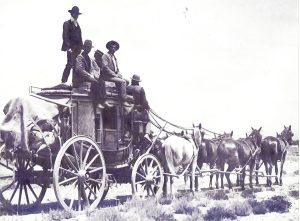
“The first indication that any of us had that anything was wrong was the sudden stopping of the stage and the climbing in of a man with a pistol in his hand. He said in a tone of command, there was no mistaking. “Throw up your hands.” Eight hands went up suddenly and without delay. He crawled into the coach and proceeded to go through each of us in turn. He commenced with Phil Nolan, whose pockets he relieved of all his cash and valuables. I was sitting on the front seat and Nolan on the rear one opposite me. He robbed the two on the rear seat first and then commenced with those on the front seat. He had finished with me and was engaged with robbing the man next to me. This necessitated the robber turning his back to Phil Nolan. As he did so, Nolan deftly reached beneath his seat and drew his pistol. Quick as a flash and quicker than I could tell how it was done, Phil Nolan shot the bandit through the back. The shot must have hit the bandit in the heart, for the latter fell over limp and died without a word. There were two robbers. The other had climbed up on top of the vehicle through which Nolan had a view of the robbers back. Nolan fired through the hole and wounded the second robber.”
“The second robber then jumped down from the coach, mounted his horse and rode around the stage coach, firing twice toward it and those inside the coach. Nolan, seeing that the robber was endangering the lives of all inside, pluckily deliberately pointed his pistol at the second robber and fired, kills him dead with this shot. Phil Nolan only fired three shots of the six in his pistol. Every one of them told and produced instantaneous death. No one besides Phil Nolan attempted to fire and to him belongs the credit of killing the two bandits.”
It is evident that the robbers were mere tyros and never engaged in such a venture before. If they had, they must have dealt with victims whose wits were lost by fright. If they had been men of experience in holding up stage coaches neither would have entered the stage coach unless the occupants had first been forced to leave it, nor would either of them would have mounted the seat with the driver unless the driver and the coach passengers were removed from the coach. I have or heard of a successful stage coach robbery wherein the robbers entered the coach or got on top of it. In doing so they both blundered and the blunders cost them their lives.”
“Of course, all of us but Phil Nolan were greatly agitated; it took us some time to collect our scattered wits and articles that had been taken from us by the robbers who held up our stage coach. The first thing that we did was to satisfy ourselves that both robbers were dead. Then we investigated to see if there were any live companions of theirs left. If there was, they evidently vanished. Possibly there were, because I remember that we only secured the horse of one of them. The horse of the other got away from us and it is possible if not probable that the animal was led away by a companion who fled when he saw the other two had been killed.”
“I saw Phil Nolan, who killed the bandits, afterward repeatedly and we spoke frequently of the tragic affair. He told me that his purpose in placing his pistol under the seat was premeditated as he had anticipated that the stage might be robbed. He had thoroughly and carefully planned how he would act in the event of a robbery. He had taken advantage of every circumstance to our favor that the robbers had given him. He had not reckoned on the robbers entering the stage coach and as soon as one of them did so and the other got on the top of the coach with the driver, he said he felt sure he was going to get them both. He told me that he had felt that he had killed the first one the minute he pulled the trigger and was pretty certain that the second was disabled when he fired at him. He said that when he got out of the stage coach to shoot again, he had determined to waste no lead, as he had one weapon from which two of its six charges had been fired.
Related Posts
Pastor Ramirez reflects on achievements in Pearsall

Bible and the Headlines

Bible and the Headlines: News You Can Use
HARTS Observes 55th anniversary