
Landowner meeting focuses on trespassers, smuggler pursuits
PROTECTED CONTENT
If you’re a current subscriber, log in below. If you would like to subscribe, please click the subscribe tab above.
Username and Password Help
Please enter your email and we will send you a password reset link.
“If it happens to you, be aware and apply…”
Local, regional law enforcement, state legislator, AG representative take ranchers’ questions
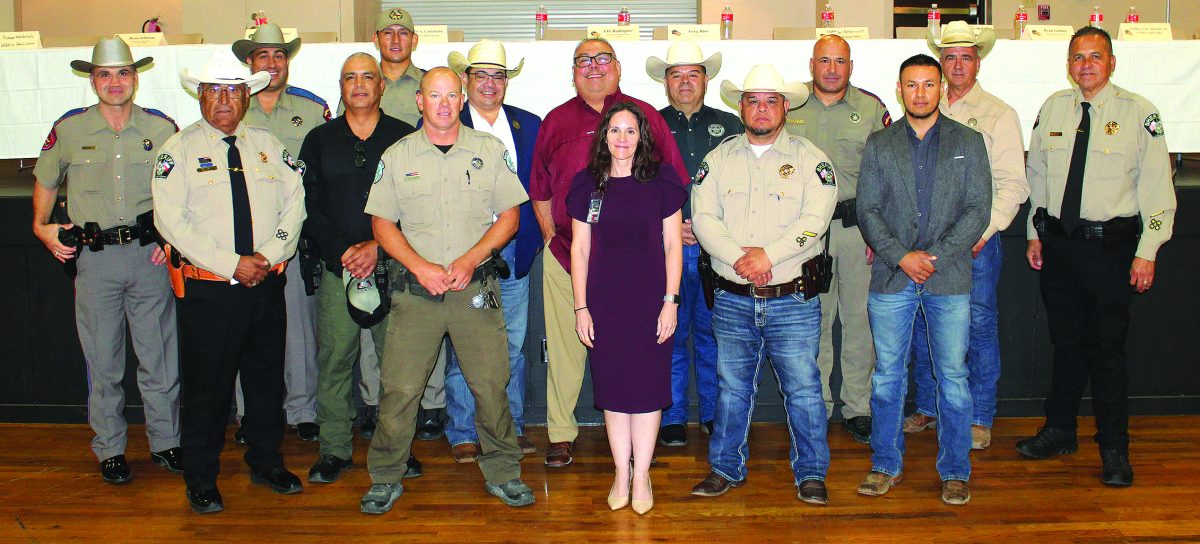
Human smuggling, trespassing by fugitives, property damage and communication between agencies were focal points of a forum held Thursday evening, September 25, at the AB Alexander Convention Center in Cotulla.
Ranchers, landowners and rural residents attended the event with a barrage of questions for many of the officers who have experienced at first hand the damage and boundary violations resulting from an ongoing struggle to intercept smugglers with contraband and undocumented immigrants through South Texas.
Among those addressing the public last week was Texas Highway Patrol Capt. Joel Betancourt, who oversees a region that includes La Salle County and who said he believes there has been a reduction in the number of smuggling attempts through the area in recent months.
“Traffic has slowed down a lot,” the captain said, but noted that his officers have detected and intercepted a number of alternate smuggling means, including a change in the routes most commonly used and an increase in ranch trespassing, as drivers have learned how to cross the Brush Country from one ranch to the next.
“They are going around town,” Betancourt said of those smuggling immigrants and evading detection. “They are going away from us. Our brush team is now working the highways. We have a lot of bail-outs, and you can claim compensation.”
For the past year and a half, property owners have been able to apply for reimbursement funds for damage caused to fences, gates and other property by drivers trying to evade law enforcement officers. In some cases, attendees at Thursday night’s forum learned, trespassers have included not only smugglers but also wanted fugitives.
Betancourt said he believes all South Texans should prepare for an increase in immigrant smuggling operations as the holiday season approaches.
The landowners’ compensation program launched in 2024 by the state of Texas allows up to $75,000 per damage claim and stipulates that applications must be filed within 90 days of an incident, although debate continues over whether victims may apply beyond that time limit if they are absentee landowners who discover damage more than three months after it has occurred.
Mayuly Brito, a program specialist at the Texas Attorney General’s Office, said the state will review all claims regardless of the 90-day time limit.
“You have more than ninety days,” Brito said at the forum. “If you’re away and come back and find damage, call law enforcement. It’s their job to define the date.
“Was there a call to Border Patrol?” Brito asked of those who investigate the possible causes of property damage. “Was the DPS involved? Maybe they have something to tie you to the date. You’re not there every day. If you’re able to show that you weren’t there, you have ninety days after you find out, per incident.
“Things change in ninety days,” Brito added. “You’re going to fix your fence. And if they hit your fence in the same place or next to it, take pictures and get a law enforcement report.”
State Representative Ryan Guillen said the Texas Legislature has made improvements to its guidelines for the compensation program, expanding the scope of property types and uses, and preventing insurance premium repercussions.
“We have extended it to include lease properties,” Rep. Guillen said. “And we prohibit insurance companies from raising your rates due to one of these types of claim.
“We originally put $36 million into the program,” the state representative said. “Very little was spent. It’s a new program. There is a $75,000 limit on damage per incident, but if it happens to you, be aware and apply.”
Brito said the program also now extends to an additional $10,000 claim for damage or loss in livestock, timber and crops, and expenses for debris clean-up. That supplement, she said, may be available for application by the end of 2025.
“Take advantage of it,” Dimmit County Sheriff Chris Castaneda said. “In our area, we have helped ranchers; we have even gone out and patched damaged fences. We had gates knocked down. I know it’s expensive, gates, wire and welding.”
La Salle County Sheriff’s Office Ranch Liaison Deputy Richard Maldonado said property owners finding fence damage must learn from officers whether the incident falls within the criteria set out by the compensation program.
“Bear in mind that is is related to border crime only,” Maldonado said. “It doesn’t apply to car crashes on the road. It must be a border-related report, a Border Patrol incident.”
All such reports, the ranch liaison officer said, are available through the county sheriff’s office, regardless of which agency handled the incident.
Ranch owner Chris Meyer said he believes many in the area are unaware whom to contact or how to obtain information on trespassing incidents.
“Who is responsible for notifying the landowners when [smugglers] go through the fence?” Meyer asked. “If I think an incident was close to my property, I will always go check my fence.”
Officers and government representatives learned from their audience that confusion remains over what procedures to follow when damage is inflicted on multiple properties in a single incident.
“They go through three ranches before they get to me,” Meyer said. “As good neighbors, we all let each other know, but the first ranch they go through might be an absentee landowner’s.
“Is the communication good enough between the agencies?” the ranch owner asked. “In the past, all the agencies used different radios.”
“A lot of it has to do with dispatch,” Ranch Liaison Deputy Rickey Galvan said. “It has to do with us. We are trying to work on it. The sheriff’s office is working on putting a notice on the gate, using GPS. We are working on getting the same system.”
“They go through multiple fences,” Deputy Maldonado said. “You can kind of determine whose property it is, but it’s not always correct.”
“We are looking into getting plaques, license plates, for every gate, instead of trying to guess,” Sheriff Hector Ramirez said of a program now being used in other counties – including Frio – to help identify property ownership. “Also, with a group app, we can keep everyone updated.
“Yes, when they go through multiple ranches, we do lose track,” the sheriff said.
La Salle County Judge Leodoro Martinez III said he believes the county has made significant strides in improving its mapping, property identification, and communication with additional radio towers in the southern portion of the county.
“We are updating our 9-1-1 system with a grant,” the county judge said, “especially on county roads. At a recent incident in Artesia Wells, for example, we could not find the gate. The council of governments is working on that.”
“In Frio County we are doing the same,” Commissioner and County Judge Representative Mario Martinez said, “and it’s working out. We issue a license plate for each gate. It solves a lot of problems.”
The Dimmit County sheriff said he believes property owners should also keep track of any valuables on their land, including items or vehicles that may be stolen by fugitives.
“Put your number on your equipment,” Sheriff Castaneda said, “so we know exactly where it came from.”
Landowners were cautioned against trying to claim salvage-type ownership of vehicles that may be abandoned during a law enforcement pursuit onto private property.
“Most of the vehicles we are recovering were stolen,” La Salle Chief Deputy Armando Romo said.
“You are required to notify the authorities if there is a vehicle abandoned on your property,” Capt. Betancourt added. “If it was used in a crime, it’s evidence. You cannot keep evidence.
“If we can prove that the vehicle damaged your property, you can submit a claim through the owner’s insurance,” the captain said. “Obviously, the owner doesn’t know about it.”
Insurance company representative Hornet Coleman said, however, that he does not believe a claim is valid once a vehicle has been reported stolen. Such claims, he said, are likely to be denied, as the damage will be recorded as having been the responsibility of the person driving the stolen vehicle.
Forum attendees learned from the DPS that improved communications and new technology are not exclusive to law enforcement. Criminal activity on the Mexican side of the border, according to DPS Sgt. JD Rodriguez, is keeping apace and includes surveillance of law enforcement movements, ranch roads and mapping potential smuggler routes.
“We are all in contact with each other, including the schools,” Sgt. Rodriguez said. “We use an app to contact each other. We can add your ranch information. We have added all the drones.
“Our federal partners are also using it,” the sergeant said of the internet application, “so we know where they are, too.
“Our communication has improved so much in the past couple of years,” Rodriguez added. “All officers have the app, and we can see where the deputies are. We can see the Border Patrol and they can see us as well.”
“When JD flies his drone, I can see what his drone is seeing,” the Dimmit County sheriff said of the program.
“When we were crossing fences and chasing people, we could look on the app and see whose properties we went through,” the DPS sergeant said. “If you hear of a bail-out near you and there’s a drone nearby, it’s more than likely one of ours.”
Rodriguez also said that while the airspace above South Texas may include military and Federal Aviation Authority controlled rights of way, civilian drone use includes Mexican cartel activity.
“We have counter-surveillance sensors,” the sergeant said. “We can see the cartel drones coming over. That happens constantly. We can see the person launching it from across the border.
“We have lots of cameras around the county,” Rodriguez added, “but we don’t typically give out the location.”
DPS Highway Patrol Lieutenant Noe Fernandez said he believes criminal elements south of the border have gathered significant amounts of data from surveillance over South Texas.
“They know where to go to avoid us,” the lieutenant said. “They have intel. They know where the roads are. Some of those roads are better than the highways.
“Some cases take place at two in the morning,” Lt. Fernandez added. “And then by daylight we find out they went through two, three or more properties.”
Landowners found few answers Thursday to questions over what options remain available to them for barring access to their land and the extent to which officers pursuing smugglers may go once on private property.
Capt. Betancourt was among the last speakers to address the audience Thursday with a caution, noting that while law enforcement agencies have improved smuggler interception and interdiction, he believes criminal activity in the region should continue to be viewed as dangerous.
“It’s all specific to the situation on the ground,” Betancourt said of response to incidents of trespass and damage. “It could be a vehicle loaded with bodies or it could be a single fugitive, wanted for murder, and he’s going into your property.
“We are not going to do more damage,” Betancourt said. “It is down to the officer on the ground to determine whether to pursue onto a property. If the gate is already busted, we are probably going to go through. It’s very subjective.”
The La Salle County Sheriff’s Office has announced it will launch a series of monthly meetings in the district courtroom at the county courthouse for all ranchers, foremen, cowboys and La Salle residents to meet officers, discuss concerns and share ideas to help improve communications and relations with area law enforcement agencies. The open forum will serve to continue talks between all stakeholders and provide updates on topics broached at last week’s forum.
The first County Roundup meeting will be held at 5:30 p.m. Monday, November 3.
Related Posts
Coin toss could decide runoff election

City’s $10M sewer upgrade underway

Freak fatal ag accident claims life of Dilley man

In full swing…
