“HONOR THOSE WHO WENT AHEAD OF ME”
PROTECTED CONTENT
If you’re a current subscriber, log in below. If you would like to subscribe, please click the subscribe tab above.
Username and Password Help
Please enter your email and we will send you a password reset link.
SPECIAL FEATURE
World War II veteran flies to DC for special tour
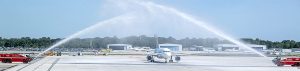
A local veteran of World War II will board a special flight in San Antonio this week for a whirlwind tour of the nation’s capital as part of a tribute to those who served their country in uniform.
During the year’s commemoration of the 80th anniversary of the end of the second world war, a number of charitable and veteran services organizations have found former armed forces personnel to recognize with the Honor Flight project, which brings the military men and women together for special visits to US war monuments.
This year, Pearsall’s Wilson Raymond Neal will be among them.
Neal was only 17 years old when he enlisted in the US Navy in January 1945, a time when conflicts were still raging in the European and Pacific theaters of war.
In Europe, the German army had been pushed back from its positions in France, Belgium, the Netherlands, Norway and the Balkans to within its own borders. The Battle of the Bulge in the Ardennes Forest in Belgium between December and January had been the last major German offensive of the war. The Allied front had begun in Sicily and in Normandy in 1944, and by early 1945 the American, British and Canadian forces had liberated France and its northern neighbors and were pushing towards Berlin from the west while the Soviet Red Army forced the German Wehrmacht out of Ukraine, Czechoslovakia and Poland, and was advancing on the capital from the east.
In the Pacific, US, British and other Allied Powers forces had begun reclaiming territories that had been seized by the Empire of Japan, including scores of islands that would be critical landing grounds and refueling stations in the gradual push toward the Japanese mainland. Those battles would include Midway, Guadalcanal for the Solomon Islands, Tarawa for the Gilbert Islands, Leyte Gulf for the Philippines, Iwo Jima and Okinawa, the last major US land offensive before reaching the Japanese mainland.
The teenager from Pearsall had been dispatched to California in May 1945 to begin his basic training. While he was there, the war in Europe ended in German capitulation after the death of Adolf Hitler. The Soviet army occupied all of Eastern Europe while the west was divided between the American, British, and French forces.
The war in the Pacific would continue through the summer.
Funeral services were held in Washingon, DC, for President Franklin Roosevelt, and his replacement in the White House was apprised of a new and powerful weapon that the United States was developing to help bring an end to the conflict.
Navy electrician’s mate Wilson Neal was undergoing his specialized training when the United States launched the Nuclear Age by dropping atomic bombs on the Japanese cities of Hiroshima and Nagasaki in August 1945.
The Empire of Japan surrendered within days in a special ceremony aboard the USS Missouri.
Wilson Neal was destined to serve in the Pacific, and he would be among those tasked in the US occupation of Pacific islands and the Japanese mainland to establish control and ensure stability in the region.
He boarded the aircraft carrier USS Princeton for the trip across the ocean. Aboard the ship, he was responsible for “topside” electrical components, including maintenance of vital systems, searchlights, emergency lighting, and the Ready Room, the special briefing chamber in which pilots were prepped for their missions.
The USS Princeton was an Essex-class carrier and the fifth to carry the name. The fourth had been sunk in the Suriago Strait in 1944.
The new ship also carried some unusual passengers on its 1946 voyage from California.
“On that trip out from Terminal Island, we were accompanied by Supreme Court Justice Felix Frankfurter,” Neal recalls. “Part of that mission was to return the body of Philippines President Manuel Quezon to his homeland.”
The exiled Filipino president had died from tuberculosis at Sarnac Lake, New York, in 1944 and had been buried at Arlington National Cemetery. His body was disinterred and shipped to the Philippines once the United States had liberated the islands from the Japanese.

“First, we made for Hawaii, and then Manila after that,” Neal recalls. “Then we were assigned to patrols around several of the Pacific islands in 1946, including those places that had been utterly devastated by war.
“I was positioned high up in that ship,” he says of the 27,000-ton aircraft carrier. “I saw what war had done to the places we visited.”
On one occasion, Neal witnessed an aircraft cash on the carrier deck.
“The pilot was coming in at the wrong angle of descent for a safe landing,” he says of the fighter plane that was trying to land on the Princeton. “He was waved off by the flag man, and he came around for a second try… but he was running out of fuel. He was waved off again, but he came in anyway, and he didn’t catch the arresting cable. So he was not being held back for a safe stop, and then his landing gear buckled and collapsed under him when he touched down. His propeller hit the ground and he was skidded sideways…
“He plowed directly into a gun mount on the ship’s deck,” Neal says. “I’m telling you, when they pulled that canopy back, that airman was trembling.”
At Tinian Island in the Marinaras, Neal was transferred to the destroyer escort ship USS Bordelon, on which he sailed to Guam.
“We were at Guam, and we had several Japanese prisoners of war who had not been released yet,” Neal says of the aftermath of the Pacific conflict. “They were in their hundreds, and they were in a sorry state. We provided for them, gave them what they needed, and that included clothing.
“But the only clothing we had for them was old,” he adds. “These were clothes that you might see farm kids wearing. There were holes in the knees… that was all that we had for the Japanese to wear.
“One day, some of the prisoners approached me, and they were able to speak some English, but I was having trouble understanding them,” Neal says. “Finally, they found a piece of paper and a pencil and they wrote me a note. It was in perfect English, and it said ‘Please, sir, can you get us some better clothing?’”
Neal falls silent as he recalls his helplessness at the prisoners’ circumstances.
“You know…,” he says quietly, “there was nothing I could do about that.”
The navy electrician served four years, four months and four days in the service, and attended California Baptist Theological College when he was discharged in 1949. He married and started a family, and later attended graduate school in Kansas City.
Neal returned to Pearsall in May 1999, to the place where he had spent part of his youth. One of ten children (nine boys and one girl), he had first moved to the city with his family in 1938. He and his brother had helped in the move down old Highway 81 (today’s IH-35) by driving a Ford Model T pickup truck loaded with pigs from Devine.
“That old truck cut out on us when we had to go up a steep incline, because the gasoline was fed by gravity… It was cold and we only had half a windshield,” he says of the move. “The wind was rushing in, and then we were stalled out.
“We climbed out and found some firewood, and my brother had some matches, so we lit a fire and kept ourselves warm,” Neal says. “Eventually, my father showed up, looking for us. We hadn’t delivered the pigs, you see.
“Well, he was a bit upset with us, but he didn’t scold us,” he recalls. “But he did tell us that we could have turned the truck around and driven up that hill backwards just fine, because the fuel would have flowed to the engine.
“We hadn’t thought of that,” he laughs. “That was something you learned on the farm.”
Neal visited Austin last week for a preparatory meeting – a briefing of sorts – in advance of the Honor Flight to DC. The tour this week includes stops at all of the nation’s memorials and special landmarks in the capital.
“I believe I’m the only World War Two veteran on this flight,” he says of the October 23 trip. “In fact, I may be one of the last World War Two veterans in Pearsall.
“There will be another Honor Flight in December this year,” he says. “It might be the last.
“I’m looking forward to this trip to honor the others and those who went ahead of me in serving our country,” Neal says of the Honor Flight. “My older brother turned 100 in April, and he also served. He and I were looking forward to making this trip together, but he has since passed.
“He would have liked to have gone,” Neal says, “so that’s why this is important to me. I’ll be making this trip for him.”
Related Posts

Bible and the Headlines: News You Can Use
Pastor Ramirez reflects on achievements in Pearsall
Bible and the Headlines

Bible and the Headlines: News You Can Use