| logout
A dignity deserved
PROTECTED CONTENT
If you’re a current subscriber, log in below. If you would like to subscribe, please click the subscribe tab above.
Username and Password Help
Please enter your email and we will send you a password reset link.
Cristo Rey Cemetery receives its Texas historical marker…
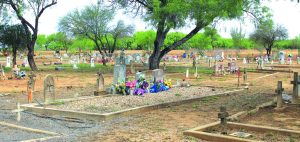
To some, the ancient cemetery beyond the southeastern outskirts of Cotulla is a remote, windblown and dusty place; to others, it is a haven of tranquility where those who formed the laboring backbone of the community are given the peace they earned.
To others still, it is a place of horror, being the site of a gruesome murder in July 2005, when a local woman fell victim to a predator who beat and strangled her, sexually assaulted her and left her for dead along with her nine-month unborn son.
It is the mixed perceptions of the site that may have contributed to its oft-neglectful treatment by generations of civic leaders and apparent mismanagement while families with long Cotulla histories have persisted in claiming it as a cherished place close to their hearts.
It is those who value the significance of Cristo Rey, however, who may yet prevail.
The city of Cotulla took delivery last week of a plaque from the Texas Historical Commission certifying Cristo Rey’s significance to the Hispanic culture and the roles that its many occupants played in the community’s early decades.
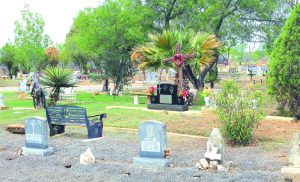
Today, there are an estimated 600 graves at the site, according to the state of Texas, although many are those of families who could not afford professionally made stone markers and crafted their own. The eclectic mix of old crosses, carved memorials, wooden shrines and endearments has been the subject of educational and historical study, notably in the recording last year of several ‘nichos,’ the grave markers made from wood, stone and glass by the immediate families of the departed.
Records indicate that Cristo Rey has been the burial place for the Hispanic families of Cotulla and La Salle County for the better part of a century, but city officials and local historians – including an advisory committee charged with organizing cemetery operations – are quick to admit that record keeping was patchy over the century, and disputes over gravesite ownership lingered for generations.

Two recent Cotulla council meetings have helped bring the issue of proper cemetery management back to the fore at the very time that the state of Texas was forging the plaque that will soon be placed at the gates of the historic site.
Local historian and author Geronima Garza told councilors on March 26 that her historical research at Cristo Rey has indicated as many as 895 people may have been buried there, with many graves possibly long lost. Garza noted, however, that a 2022 court order by District Judge Russell Wilson has been largely ignored when it should have forced a local organization to put order to the cemetery’s records and ongoing management.
Garza showed that Cristo Rey was effectively founded in 1930 with the purchase of 10 acres “by the poorest of the poor” for $300. Since then, both she and City Attorney Steve Pena have said, the cemetery has lacked organization.
In many cases, both Garza and Pena have indicated, families unable to afford formal funerals may have buried their loved ones at Cristo Rey without permission and without markers.
The city put ground-penetrating radar to use two years ago on four acres at Cristo Rey and found indications of burials that lie outside the cemetery’s plot lines and, in some cases, under footpaths or at the edges of roads. The radar also showed six remaining acres of cemetery – presently an open area without trees or paths – contains no graves.
Garza lamented the lack of action by a cemetery organization when she addressed the council in March and said she believes none of those held responsible for following the court order have met
any of the requirements laid out by the judge.
“Board meetings have been canceled,” Garza said in March. “Many items ordered by the judge have been put on the back burner.
“We need a full-time position hired,” she added, “so that we can get going on this.”
Judge Wilson had ordered that a representative of each stake-holding entity be a part of the cemetery advisory board. Following his decision, City Hall has confirmed it sets aside a $50,000 budget line for Cristo Rey and maintains utilities at the site. For its part, the La Salle County government maintains the cemetery grounds.
Garza said she has asked the county to stop using herbicides and pesticides at Cristo Rey because the chemicals appear to be affecting the habitat of the endangered Texas horned toad, of which some continue to live at the cemetery.
“My understanding is that the city did what was told to them in the lawsuit,” Cotulla Mayor Sandra Luna said at the March meeting. “Obviously, the board is not doing its job.”
“We have a cemetery there that people are being buried in and we don’t know what’s going on there,” City Administrator David Wright said.
“The problem Cotulla has is that the same people are on all the boards,” Atty. Pena said last month. “The city can stop a burial and require a permit. Nobody should be going out there and burying anybody. That’s city property. It’s reprehensible that people are going there and burying anybody.”
The city attorney added that a board created by the city for cemetery management does not have the authority to act independently and serves only in an advisory capacity.
“We need to tell the funeral home that they can’t bury anybody out there without a permit,” Pena said. “Get a professional to come in. The committee needs to do only what the council wants. The actual running of it has to be done by the city.”
A new sense of order to the cemetery operations saw daylight at the council’s following meeting, Thursday, April 9, when Atty. Pena introduced the foundations of an ordinance that affirms the city’s control.
“Essentially, operations are unchanged since the lawsuit by the county to take over,” the city attorney said last week. “The idea is for the city to get an ordinance that new interments require permits, documentation by the city, and that we maintain a map of the burial plots.
“This will bring some order to the process that for the last hundred years has just been whatever somebody feels like doing,” Pena said. “This creates a management committee for the cemetery. We have a very willing county and commissioners’ court for a historical site. The ordinance sets out the process to be performed.”
Pena added that the city will establish a fee schedule for burials and said families may be encouraged to use a grave liner or opt for a full concrete vault, although both he and the council concurred that the cost of such additions may run between $1,000 and $2,500. Those costs were corroborated by Mario Aguero, owner of the Peters Funeral Home, present at the April 9 meeting.
While full historical records for the cemetery may be sparse for its near-century existence, the city attorney contended that a new ordinance may dictate that all records should be in the city’s hands.
“The current advisory board has documentation of burials at the site,” Mayor Luna said. “The records are incomplete.”
“Any records held by anybody are the property of the city,” Pena said. “We have got to know who is in there.
“What you’ve really got out there is a historical area,” the attorney said. “We need to check the brush area. Who knows what’s out there.”
Councilors hesitated to enact the initial ordinance and agreed to bring the issue back to the table in June, by which time legal representatives of the city and county will have delineated responsibilities, and councilors will have considered whether to order a halt to all burials in Cristo Rey’s historically significant sector.
Family plots in which space has been allocated for survivors who have yet to join their loved ones will remain open, according to the council’s present consent.
“It’s good to see there is some record keeping, some order,” the funeral home owner said. “It has been a challenge, interring human remains. There’s no one to turn to, to decide if it is truly a family plot.
“It’s your cemetery,” Aguero added, “but you’re dealing with perpetual care.”
Aguero told councilors that he believes at least 95 percent of the burials at Cristo Rey have been undertaken without a grave liner or concrete vault.
Councilors have also agreed that discussions should begin on budgeting security measures for the historic site.
“We need lights out there,” Atty. Pena said last week. “Lock it up at night. It can’t just be a place where people go and do whatever. We all know what happened out there.”
“The cows were crossing through there,” Councilor Mary Koraleski said of a neighbor’s poorly maintained ranch fences and incursions by livestock. “They’re stomping on our cemetery.”
“People want to follow the rules,” Pena said, “but they’ve got to know what the rules are.”
When the historical marker for the cemetery is planted at the site later this month, those whose loved ones are buried beneath the trees and palms may find comfort in knowing that the dignity they sought for their ancestors at rest may soon be better established. Meanwhile, the city will have set the groundwork for an orderly management of the place its elected leaders have acknowledged as being of vital significance to the cultural heritage of their community.
Posted in Breaking News, News
Related Posts
Fleeing cyclist tasered, hit with felony drug charge
June 10, 2026

Judge hits Frio county plaintiffs with $25k fee
June 10, 2026
Heads it is: Martinez claims victory
June 10, 2026