FRIO’S EARLY TIMES
PROTECTED CONTENT
If you’re a current subscriber, log in below. If you would like to subscribe, please click the subscribe tab above.
Username and Password Help
Please enter your email and we will send you a password reset link.
26th annual Pioneer Day set for Saturday, March 22, in Pearsall
Contributed by
Mona Hoyle
More than two centuries have passed since the Spaniards and French explored our country and blazed the trail from the Rio Grande at San Juan Bautista below Eagle Pass to San Antonio, then northwest to Nacogdoches, San Augustine and Louisiana.
According to tradition and history, this road was first traveled by St. Denis in the year 1714, and became very important. It was the original and most used route in the building of the missions at San Antonio. This trail, the historic Presidio Road, traverses the northwest corner of Frio County, created in 1858 with the town of Frio City as the county seat.
The county comprising some 1,036 square miles and embracing various fertile soils, was then under the jurisdiction of Bexar county. Also, at one time it was attached to Medina County. The name was derived from the Frio (cold) River, which winds its way through the rich land.
On June 24, 1871, the legislature ordered that B.A. Sheidler, H.M. Daugherty and John B. McMahon appointed justices for the peace, and an election was called for July 17, 1871. W.C. Daugherty was then elected district clerk and E.C Woodridge, Sheriff. At their first meeting on August 8, 1871, A.L. Oden was appointed to lay off the town of Frio City, in Frio County. The sale of lots was advertised in the San Antonio newspaper.
The town was founded on the Frio River, just below the Presidio Crossing, a beautiful spot. The original crossing is still used, being maintained by the ranch owners of the vicinity.
Here, too, Santa Ana, with his army, spent some time in resting before his final march to the Alamo. Also a story is told of a battle in Elm Valley, nearby, where man years ago, gun barrels were found. In 1900, a Mexican vaquero unearthed a gun and pistol with flint locks, a sword hilt, decayed bones and bits of military uniform. The sword hilt bore insignia of Spanish or Mexican origin.
Later in 1836, Santa Anna, with his troops, entered Texas by way of Presidio at San Juan Bautista; also, when General Woll invaded Texas in 1842, he entered and departed by way of Presidio at this point; then again General Ugalde, with several hundred troops crossed the Rio Grande into Texas at the same place to chastise a band of Indians, and a battle was fought somewhere near the Frio River crossing. It is possible this forgotten battlefield could be traced to any one of these events. Many fights occurred which were not chronicled in history.
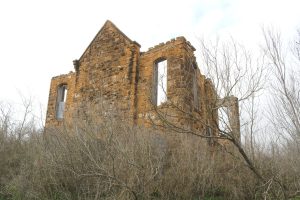
The onetime courthouse that stood at the center of Frio Town during the early years of the region’s settlement is reduced to a ruin today, rarely visible to the public.
The Yo lo Digo Creek tributaries of the Leona River, it is said, received their names from the following incident: Mexican troops were camped near Elm Creek. Sentinels were stationed on the highest hill near where these creeks have their sources. For some reason the sentinels failed to detect the approaching enemy. As the sleeping soldiers were charged, too late the warning was given. Someone asked, “Who said so?” Another replied “yo lo digo.” (I say it.) Berry Creek, another tributary of the Leona, was named for Tillman Berry, father of J.E. (Jim) Berry, great grandfather of the late Jack Berry, Esther Berry and Ruth Woodward. “Los Burros” or Jack Creek received its name from a band of wild “burros” that ranged along the creek November 28, 1871, the county court ordered that W.C. Daugherty receive bids on a 20×40-foot “California” house, with a 10-foot partition. This was to be used as a court house. The structure was built out of lumber cut from cypress trees that grew along the Frio River and was roofed with shingles made nearby. The lumber was trekked by ox wagon some eighty-five miles from an area near where the town of Leakey now stands. The courthouse was whitewashed inside and out for the sum of $20 in coin. In 1877, that building was destroyed by fire, and in 1878 was replaced by a two-story edifice of native stone, very beautiful in its simplicity. The stairway with its gracefully curved railing of walnut was greatly admired in its day. The contractor of this building failed to meet his contract to build this building and W.J. Slaughter, one of the bondsmen, assumed full charge, completing the building at his own expense. Some of the walls of the building are still standing. Many notorious characters of early days were locked within its walls, among them Sam Bass, Jesse and Frank James, these not for criminal activity but for minor offenses.
The first grave in the Frio City cemetery was that of Calvin Massey, killed by Indians. The second, of Wesley Hile, age seventeen, son of W.S. Hiler, killer by a horse. A number of Indian victims are buried there, their graves unmarked and most of them forgotten.
In the spring of 1873, Mrs. Ed Massey saw the Indians kill her father-in-law, Calvin Massey. Unaided, with her three small children, she managed, under cover of the Frio River banks, to reach the town in safety. The Indians, forty-five in number, were followed but made good their escape.
In the fall of 1876, at the break of day, Billie Allen and Jim Berry were holding a herd of cattle near the Indian Crossing on the Frio River just above the mouth of Elm Creek. Jim Berry, before seeing them, rode within twenty-five yards of sixteen Indians, lined abreast. On sight, Berry turned, making his way quickly to the Live Oak motte nearby. Allen did the same. For some unaccountable reason, the Indians did not molest the men, but turning, went on up the creek to W.L. Slaughter’s sheep camp where they killed William Rittberg, the foreman, and four Mexican sheep herders. Going on to the Leona valley that same day, they killed Mr. Butler and Nick Brian, who were employed by Mont Woodward, W.J. and C.H. Slaughter. In fact, in 1878 the Indian raids were so frequent that the citizens felt their inability to cope with them and called on the State for Ranger protection.
Major John B. Jones marched his escort company to Frio County. On about December 1, 1876, Company “A” with Neal Coldwell as captain, made camp on Elm Creek, three miles southwest of Frio City; hence, the historical “Ranger Camp” whose site is on the south bank of Elm Creek. A short distance from the camp was a beautiful level prairie known as “Soldier’s Prairie,” on which the Rangers made a race track were they exercised their horses.
The last raid in the early spring of 1877 was made on the Caven Woodward and Louis Oge ranch. Fifty head of horses were being driven away. A party of men was in pursuit. The Rangers were notified, and were also in pursuit. The Indians, realizing their inability to escape, left the horses and rode away. No lives were lost in the encounter.
In 1878, a lone Indian slipped into a section of Frio City. Sheriff J.C.B. Harkness, with a number of citizens rushed to the scene. During the excitement over the accidental discharge of the sheriff’s gun, which caused the loss of one of his toes, the Indian quietly disappeared.
Information for this article provided, in part, by Mrs. Artie Roberts for the Frontier Ties Magazine
The Frio Pioneer Jail Museum Association will host its 21st annual Pioneer Day Celebration on March 23, on the grounds of the Museum. Come and help us celebrate our pioneers and our history.
Related Posts
Pressure mounts to remove Moran
OFF AND RUNNING
Researchers launch sterile fly drop to combat NWS