New world screwworm: Distaster declared, checkpoint established
Eradicated in 1966, species’ return has experts scrambling to control infestation
Nearly a year after farmers and ranchers were first notified of a potential threat to their agricultural operations, the New World screwworm (NWS) outbreak was confirmed in La Salle County on Monday.
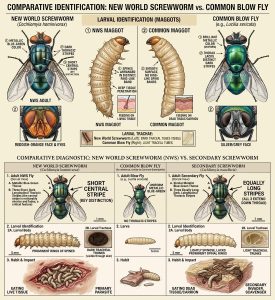
The metallic green-blue colored fly with large orange eyes is about twice the size of a common housefly. It earned its harrowing name from how it feeds, which involves burrowing into the open wounds of warm-blooded hosts.
A single female fly can lay 100 to 400 eggs into mucus-rich areas – including the eyes, nose, mouth – as well as any open lesions on animals and humans.
Once hatched, the larvae use sharp mouth hooks to tear into living tissue and start burrowing into flesh. This causes excoriating pain and a rapidly expanding infestation that, if left untreated, is routinely fatal to the host.
“This can cause quite a bit of damage as they tear at the tissue with their sharp mouth hooks,” Texas A&M University AgriLife Research agents said. “The wound gets bigger and deeper as more eggs hatch and larvae feed. If wounds go untreated, infestations can lead to serious harm or be fatal.”
While cattle, sheep, swine, and horses are the most commonly affected livestock, domestic cats and dogs are highly susceptible.
According to Texas State Representative Ryan Guillen, as of Monday evening there are five confirmed cases – two calves in Zavala County, one calf in La Salle County, one goat in Gillespie County, and one dog in Lea County, New Mexico.
Guillen noted the domestic dog case was originally classified in Andrews County; however, the case is attributed to the movement of a companion animal from Mexico.
Following the initial confirmation in Zavala County, state officials established a livestock inspection checkpoint along Hwy 83 near Crystal City to monitor all livestock transport vehicles.
NWS, scientifically known as Cochliomyia hominivorax, is a parasitic fly primarily found in South America, Cuba, Haiti, and the Dominican Republic. However, recent reports indicate the NWS has spread into Costa Rica, Nicaragua, Honduras, Guatemala, El Salvador, Belize, Mexico, and Texas.
While most modern Texans have never encountered the parasite, older generations of ranching families vividly remember the devastating toll it took on the industry before it was successfully eradicated from the state 60 years ago.
The species was the first on which the sterile insect technique was tested and then applied in a natural environment, resulting in its control and systematic eradication from the United States, Central America, and parts of the Caribbean beginning in the 1950s.
In November 2024, the United States Department of Agriculture (USDA) temporarily suspended cattle and bison imports from Mexico after a positive detection of NWS in southern Mexico.
While imports resumed in February 2025, under a comprehensive pre-clearance agreement, the parasite continued its rapid northward march.
Despite an agreement with the USDA and Mexico to implement the comprehensive pre-clearance inspection by May 2025, NWS was detected in Central America, some 700 miles from the Texas border.
By July 2025, a positive case was confirmed some 370 miles from the southern border; within two months another infected animal was reported less than 70 miles from the border.
In response to the building crisis, Governor Greg Abbott issued a disaster proclamation on June 5, stating that ‘the spread of the NWS threatened Texas’ livestock industry and economy and posed an imminent threat of widespread and severe property damage for all Texas counties.”
According to a press release from Abbott, Texas opened a sterile fly dispersal facility in February, established a livestock insects research laboratory in Kerrville in March, and deployed 8,000 fly traps along the southern border in May.
Furthermore, the detection of NWS in a three-week-old calf in Zavala County on June 3, prompted responders to establish a 20-kilometer infested zone with quarantine and movement controls for warm-blooded animals in Uvalde and Zavala counties.
The domestic outbreak has already triggered international economic fallout, with Canada announcing a temporary ban on all U.S. cattle imports.
Historically, Texas achieved total eradication in 1966 through surveillance, quarantine, the Sterile Insect Technique (SIT).
SIT relies on breeding massive numbers of flies in a laboratory setting. During the pupal stage, the insects are subjected to a specific irradiation exposure, damaging their chromosomes and making them sterile.
The technique relies on sterilizing the flies without damaging their ability to fly, finding a non-sterile wild female, and being accepted for mating. Female flies mate only once in their lifespan.
Sterilized males are released either through targeted ground operations or widespread aerial dispersal in massive numbers at regular intervals to overwhelm the wild female population with sterile males and suppress mating with wild males.
This is the tactic that the Knipling-Bushland U.S. Livestock Insects Research Laboratory in Kerrville is implementing.
On Monday, Agriculture Commissioner Sid Miller renewed his call for the USDA to immediately deploy the Screwworm Adult Suppression System (SWASS).
“For over a year, I’ve been pushing the USDA to bring SWASS back into the fight,” the commissioner said. SWASS helped eradicate screwworm from the U.S. once before, and it can help stop this outbreak before it reaches even deeper into Texas.”
A number of measures have become commonplace in southern states over the past six decades. Historically, ranchers have altered breeding dates to avoid birthing during fly season.
Despite these large-scale initiatives, some local producers feel left in the dark.
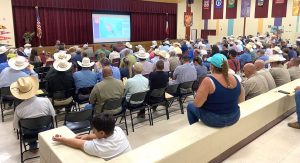
Ranchers in southern La Salle County expressed frustration over a perceived lack of direct guidance on how to manage their herds on a day-to-day basis.
“No one is telling us what we need to do to protect our animals,” the rancher said. “My husband and I come from a long line of cattle owners with an extensive background in caring for our cattle. The best advice we have is to inject your animals with ivermectin and also coat their skin with ivermectin.”
The rancher explained that using the medicine as an injection and topical remedy treats the animal from the inside and also deters the flies.
Key signs of screwworm infestations can include wounds that appear not to be healing or have excessive drainage or odor. Animals may exhibit irritated behavior such as head shaking, the smell of decaying flesh, and maggots in the wound of a living animal.
Animal owners should immediately contact a veterinarian if their living animal has larvae. The infected animal should immediately be confined for wound care, and all larvae should be removed and placed into alcohol.
Once larvae are removed, the wound site must be treated with topical pesticides and monitored until it fully heals. When dealing with livestock, all other animals in the herd should be checked for wounds and larvae.