Demolition begins at iconic store on plaza
PROTECTED CONTENT
If you’re a current subscriber, log in below. If you would like to subscribe, please click the subscribe tab above.
Username and Password Help
Please enter your email and we will send you a password reset link.
Building could not be salvaged, City Hall says
A building that served for generations as the backdrop to community events in the heart of Cotulla’s Hispanic historical district is being leveled this week.
Cotulla streets and parks department crews began the process of demolishing the former Botanica Vasquez, previously known as Red Store #3, on the north side of Plaza Florita, Monday morning, July 15.
Department head Robbie Thomas said Monday that he expects to have completed the demolition within ten days and that the site will be completely leveled.
Wood and metal extensions and a covered porch were torn down Monday morning to expose the original one-story concrete-block building.
The site has been earmarked for historic restoration as part of a cultural district highlighting Hispanic heritage and the contributions of La Salle and Cotulla families to business and education in the community. City Hall has reported that staff have begun examining options for the site, including reconstruction of a traditional store, a multipurpose facility with vendor booth spaces, a youth recreational facility, and parking spaces for the plaza.
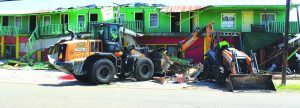
The former Botanica Vasquez / Red Store #3 is demolished this week. The building had served as a grocery store, refreshment vendor and boarding house before it was sold to the city of Cotulla last year for $135,000. The site at the northern edge of Plaza Florita is being studied for construction of a multipurpose building and parking spaces for events in the community’s Hispanic heritage historical district.
(CURRENT Photo: Marc Robertson)
The structure served for decades as a grocery store and refreshment barn in the center of the Hispanic district, notably serving drinks and snacks during festivals at the adjoining plaza. It was expanded by the Vasquez family during the height of the Eagle Ford Shale energy industry boom and accommodation shortage in Cotulla when micro-apartments were added in a second story. The building’s iconic Tuscan red paint was also covered in bright green for the past decade.
The city purchased the building for $135,000 in 2023 and councilors voted on Thursday, July 11, to order its demolition after learning that the structure was unstable, that its foundation was cracked, and that it had suffered extensive water damage.
“An inspection revealed that it would not be viable or cost-effective to salvage the building,” Cotulla City Administrator David Wright said last week. “Our prior plan was to create a parking lot for the plaza, but that’s not my decision.
“Beautifying the area, that was the motivation,” Wright said at Thursday’s council meeting.
“I’m for it, for that,” Councilor Manuel Rodriguez said.
The council voted unanimously in support of a motion by Mary Koraleski, seconded by Trish Garcia, to demolish the building.
Plaza Florita has been the focus of council attention as a place of interest through its listing on the National Register of Historic Places for its part in the community’s Hispanic heritage and the stories of countless families living on the east side of Cotulla. The city has purchased a number of empty or derelict buildings on lots surrounding the plaza with a view to restoring the appearance of the neighborhood while creating a public space for festivals, performances, ceremonies and family events.
Also slated for demolition and reconstruction elsewhere are the plaza’s 1999-built pavilion, cinderblock restroom building, and playground equipment, which will be cleared to help restore the open area to its 1930s appearance. The additions were funded by a grant from the Texas Department of Parks & Wildlife for public recreation facilities. If they are not rebuilt at another site, their grant funds must be returned to the state.
The former Guadalupe Hall and Jimenez store, likewise facing the plaza, have also been purchased by the city and are subject to historic restoration and repurposing for community functions.
Funding for the projects has come from the city’s hotel occupancy tax revenues, which may only be used to enhance tourism. Beautification efforts, historic preservation, festival promotion, and establishment of public facilities that attract visitors and thereby feed the local economy are the principal goals for the fund.
The city collects a surcharge on every hotel room booked in Cotulla and estimates that revenues to the special tax fund will exceed $1.5 million for 2024.
Related Posts

Trevino is Pearsall’s new police chief

Two go to prison in human smuggling cases
Screwworm cases double in two weeks